

Bug Reports - Flutter
Let users report bugs from inside your Flutter app. Built-in or custom UI, screenshots, attachments, i18n and shake to report.
Bug reports enable users to report issues directly from the app. Measure SDK provides two approaches to implement bug reporting.
Session Timeline
When a bug report is captured, it automatically comes with a session timeline that includes all events that occurred 5 minutes before the bug report was submitted. This provides rich context to help diagnose and fix the reported issue.
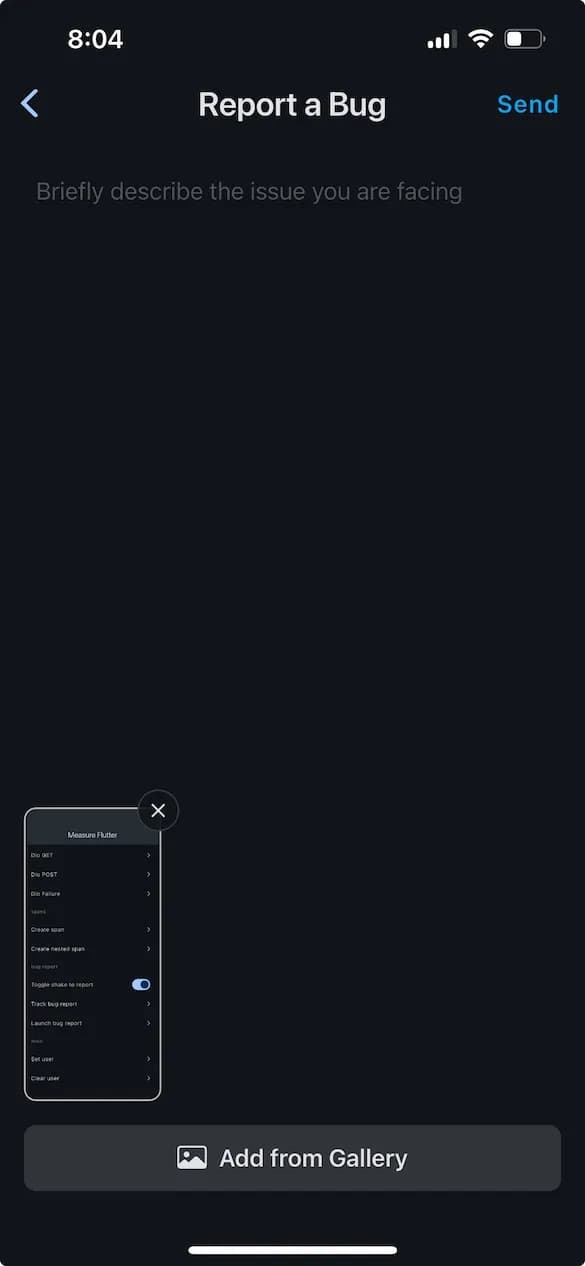
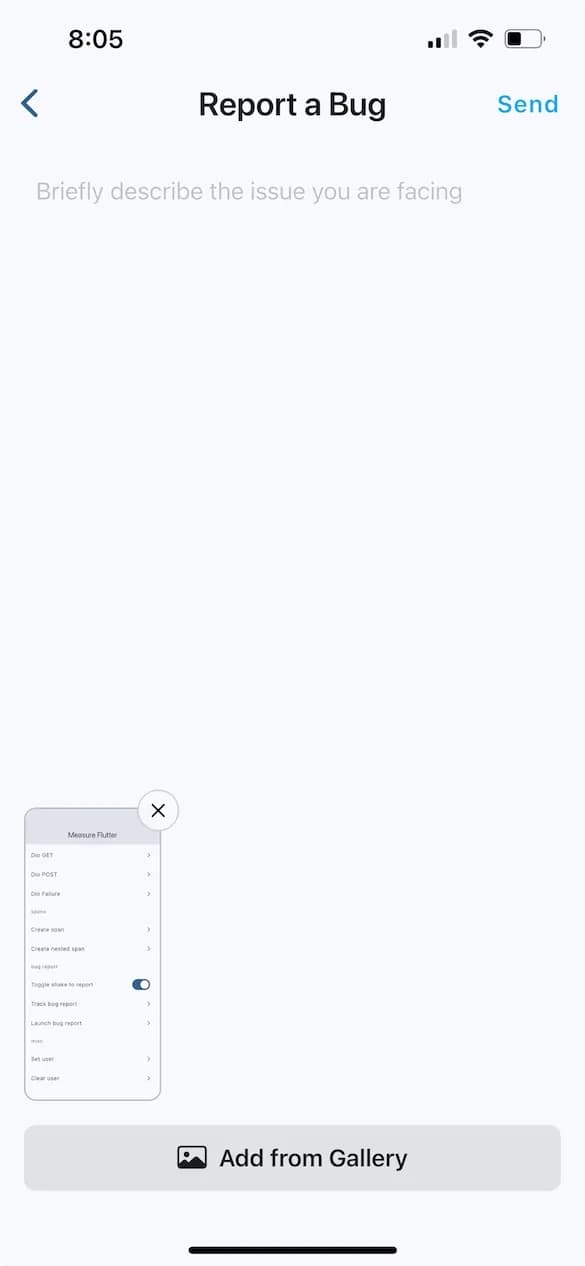
Built-in Experience
iOS
| Dark Mode | Light Mode |
|---|---|
 |  |
Android
| Dark Mode | Light Mode |
|---|---|
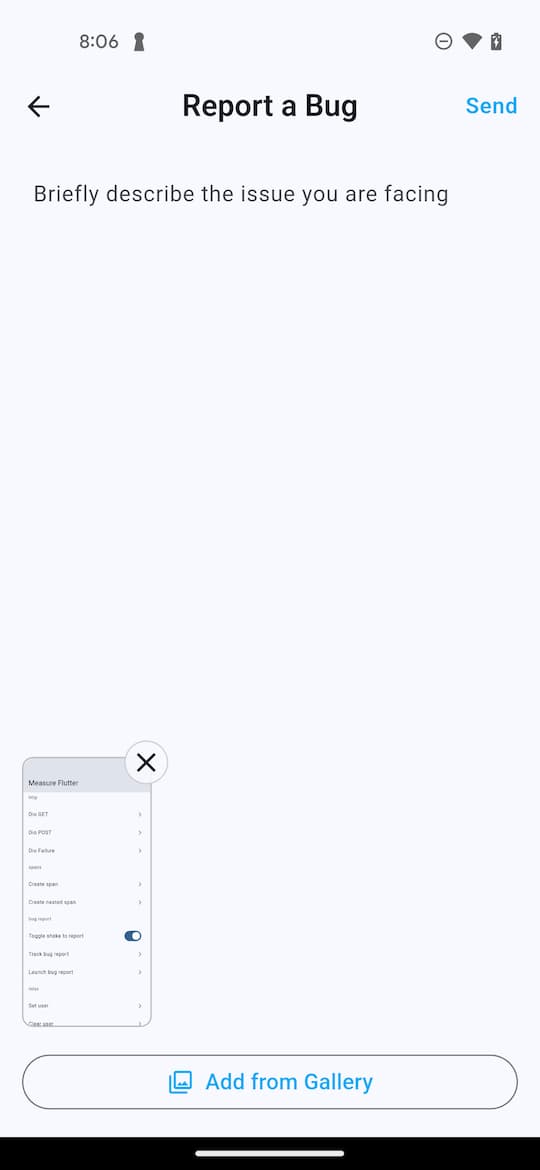 | 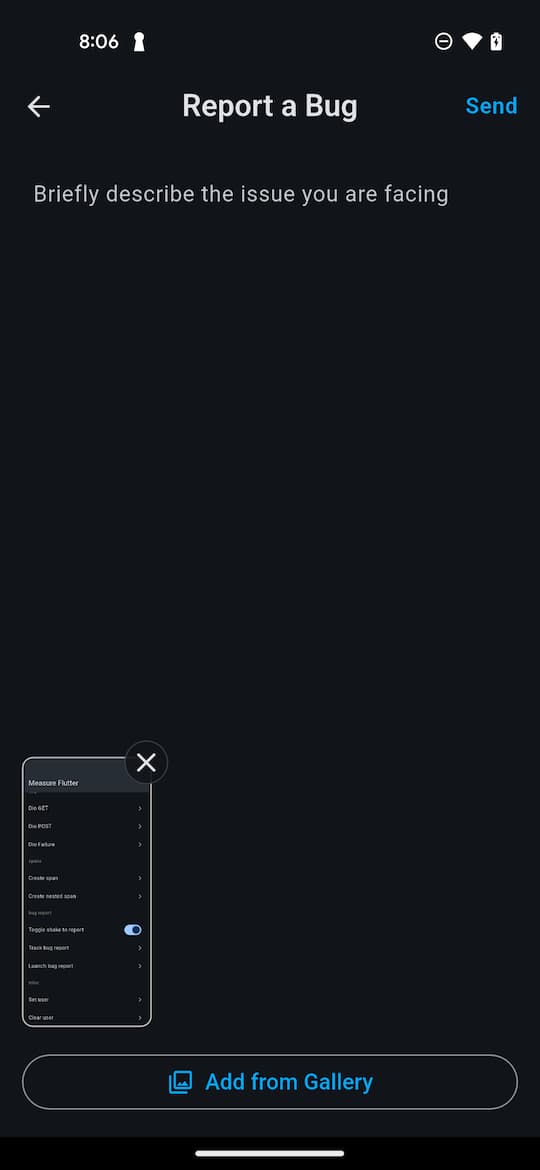 |
Launch the default bug report interface by using Measure.instance.createBugReportWidget method. Usage:
final widget = Measure.instance.createBugReportWidget();This is typically launched as a new screen:
final navigatorState = Navigator.of(context);
navigatorState.push(
  MaterialPageRoute<Widget>(
    builder: (context) => Measure.instance.createBugReportWidget(),
    settings: const RouteSettings(name: '/msr_bug_report'),
  ),
);
Adding a screenshot
Include a screenshot when opening the bug report widget. The screenshot is automatically redacted based on the screenshot mask level configuration.
final navigatorState = Navigator.of(context);
final screenshot = await Measure.instance.captureScreenshot();

if (context.mounted) {
  navigatorState.push(
    MaterialPageRoute<Widget>(
      builder: (context) => Measure.instance.createBugReportWidget(screenshot: screenshot),
      settings: const RouteSettings(name: '/msr_bug_report'),
    ),
  );
}
Theming
Override the default primary color for the "Add from Gallery" and "Send" buttons:
Example:
Measure.instance.createBugReportWidget(
  theme: const BugReportTheme(
    colors: BugReportColors(
      primaryColor: Colors.lightBlue,
    ),
  ),
)
I18n
Localize widget text using the BugReportTheme object:
Measure.instance.createBugReportWidget(
  theme: const BugReportTheme(
    text: BugReportText(
      appBarTitle: 'your-localized-text',
      sendButton: 'your-localized-text',
      inputPlaceHolder: 'your-localized-text',
      addFromGalleryButton: 'your-localized-text',
    ),
  ),
)
Custom Experience
You can build a custom experience to match the look and feel of your app. Once the bug report is entered by the user, trigger the Measure.trackBugReport method.
// Track the bug report
Measure.instance.trackBugReport(
  description: "...",
  attachments: [],
  attributes: {},
);
Attachments
Bug reports can be enhanced with attachments. A maximum of 5 attachments can be added per bug
report. You can add screenshots to bug reports by using the Measure.captureScreenshot method.
final screenshot = await Measure.instance.captureScreenshot();

Measure.instance.trackBugReport(
    description: "...",
    attachments: [if (screenshot != null) screenshot],
    attributes: {},
);
Limits
- Each bug report can have a maximum of
5attachments. - The bug report description can have a maximum length of
4000characters.
Add Attributes
Attributes allow attaching additional contextual data to bug reports. This helps in adding relevant information about the user's state, app configuration or other metadata that can help with debugging.
- Attribute keys must be strings with a maximum length of 256 characters.
- Attribute values must be one of the primitive types:
int,long,double,floatorboolean. - String attribute values can have a maximum length of 256 characters.
To add attributes, use the optinal attributes property in createBugReportWidget:
final attributes = AttributeBuilder().add("order_id", "order-12345").build();
Measure.instance.createBugReportWidget(
  attributes: attributes,
);
Or add attributes with trackBugReport method.
final attributes = AttributeBuilder().add("order_id", "order-12345").build();
Measure.instance.trackBugReport(
  description: "...",
  attachments: [],
  attributes: attributes,
);
Shake to Report Bug
A shake listener can be set up to allow users to report bugs by shaking their device. This is particularly useful for quickly reporting issues without navigating through the app.
Use MsrShakeDetectorMixin on top level widget in your app if you want to enable shake detection
across the app. Setting up this mixin will automatically enable shake detection and provide
a callback in onShakeDetected where you can launch the bug report interface. For example:
class ShakeExample extends StatefulWidget {
  @override
  State<ShakeExample> createState() => _ShakeExampleState();
}

class _ShakeExampleState extends State<ShakeExample>
    with MsrShakeDetectorMixin {

  @override
  void onShakeDetected() {
    _launchBugReport();
  }

  void _launchBugReport() async {
    final screenshot = await Measure.instance.captureScreenshot();

    Navigator.of(context).push(
      MaterialPageRoute(
        builder: (context) => Measure.instance.createBugReportWidget(
          screenshot: screenshot,
        ),
      ),
    );
  }

  @override
  Widget build(BuildContext context) {
    return Scaffold(
      body: Center(
        child: Text('Shake device to report bug'),
      ),
    );
  }
}
Enable/Disable shake detection
To conditionally enable/disable shake detection call disableShakeDetection and
enableShakeDetection methods available in the mixin.
Think this page can be better?
Open an issue